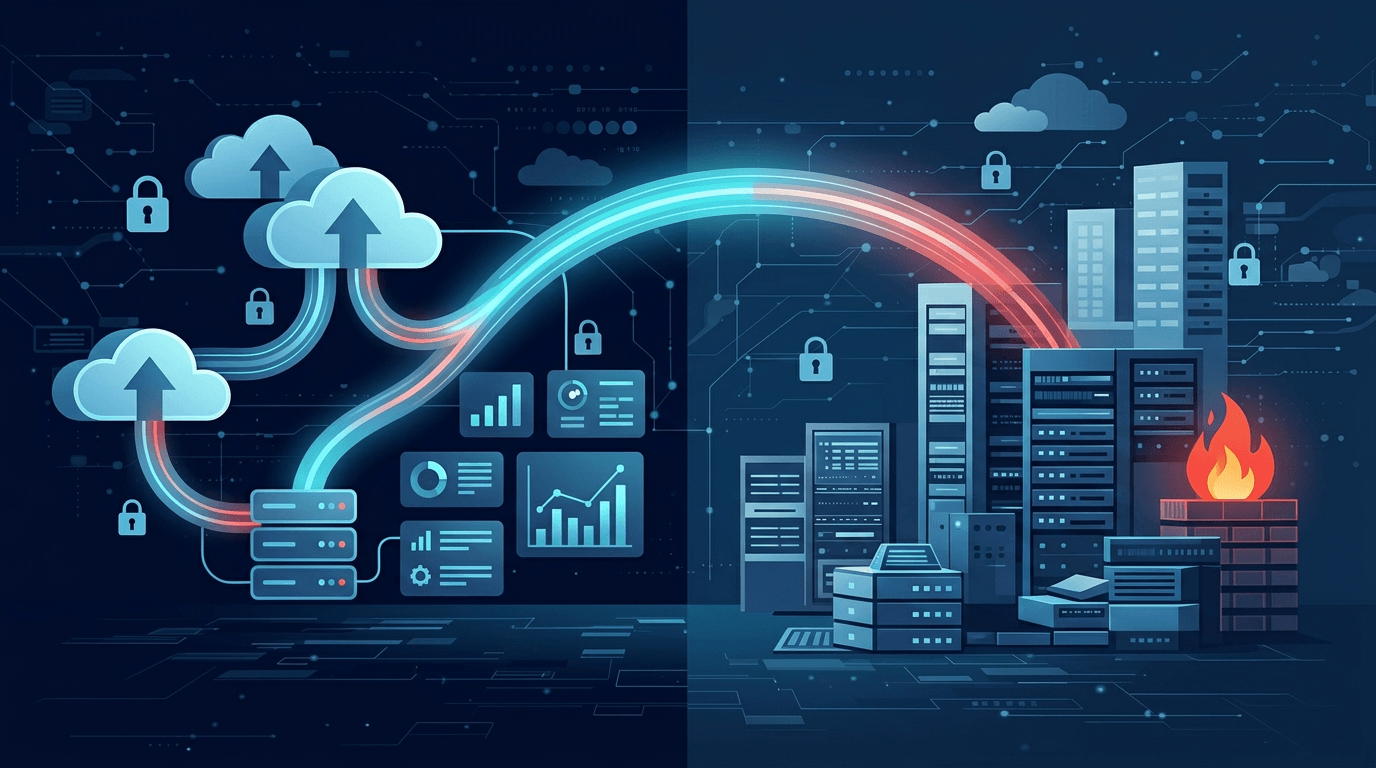
One of the most important decisions IT managers face is choosing between cloud infrastructure and on-premise systems. Each approach offers distinct advantages and challenges, and the right choice depends on business requirements, budget, and regulatory obligations.
Benefits of cloud infrastructure
Scalability
Cloud infrastructure allows rapid scaling of resources based on actual business needs. Resources adjust dynamically, without additional hardware investments.
Lower initial costs
There is no need for large upfront investments in servers and equipment. Operational expenses replace capital expenditures.
Accessibility and flexibility
Applications and data are accessible from anywhere, supporting remote work and ensuring high availability. For businesses with teams spread across multiple locations or employees working from home, this is a practical advantage that directly impacts productivity.
Benefits of on-premise infrastructure
Full system control
On-premise infrastructure provides complete control over hardware, software, and security policies, which is critical for certain business environments.
Regulatory compliance
For specific industries and sensitive data, on-premise systems simplify compliance with legal and regulatory requirements. In BiH and Republika Srpska this is a common argument in favor of local solutions — the Personal Data Protection Act requires adequate protection of personal data, and sectors such as accounting, healthcare, and public procurement have additional specifics around storage location and access control. Many local companies working with the public sector or operating in regulated industries choose local or hybrid infrastructure precisely to maintain clear control and be able to respond to audits without complications.
Predictable costs
After the initial investment, ongoing maintenance and operational costs are more stable and easier to plan over time. For businesses with consistent workloads and no expectation of sudden capacity changes, an on-premise server can be more cost-effective than cumulative cloud subscription fees over a five-to-seven year period.
Hybrid approach
Many companies choose a hybrid infrastructure model that combines cloud and on-premise systems. Rather than choosing one or the other, they thoughtfully decide what goes where — and gain the benefits of both approaches while minimizing their respective drawbacks.
A typical example: accounting software and invoicing are moved to the cloud to be accessible to a remote accountant and an external audit firm. At the same time, the customer database and internal operational data stay on a local server physically located on company premises, under full management control.
This approach enables:
- Keeping sensitive data on-premise with clear access control
- Running cloud services for applications that require multi-location access
- Cost optimization — paying only for what is actually used in the cloud
- A gradual transition without a radical break from existing infrastructure
Real-world example
A manufacturing company in Republika Srpska was running all systems on a single local server — from ERP to email. The server was aging, expensive to maintain, and lacked adequate data loss protection. Instead of replacing everything at once, a hybrid model was introduced: email and backups were moved to the cloud (lower cost, higher reliability), while the ERP remained on-premise because it was tightly integrated with factory machinery and the internal network. Result: total annual IT costs were reduced by around 30%, and backup reliability improved dramatically.
Our recommendation
There is no one-size-fits-all solution. The optimal infrastructure depends on your business model, security requirements, and long-term growth plans.
Practical tip: list your systems and answer two questions for each — how sensitive is the data, and how much does it need to be accessible from multiple locations? Those two parameters most often determine where each system should live.
KOMTEL helps organizations evaluate their needs and implement infrastructure solutions that ensure stability, security, and scalability. If you are unsure which model suits your business, reach out — a free initial assessment is the starting point for every conversation.