
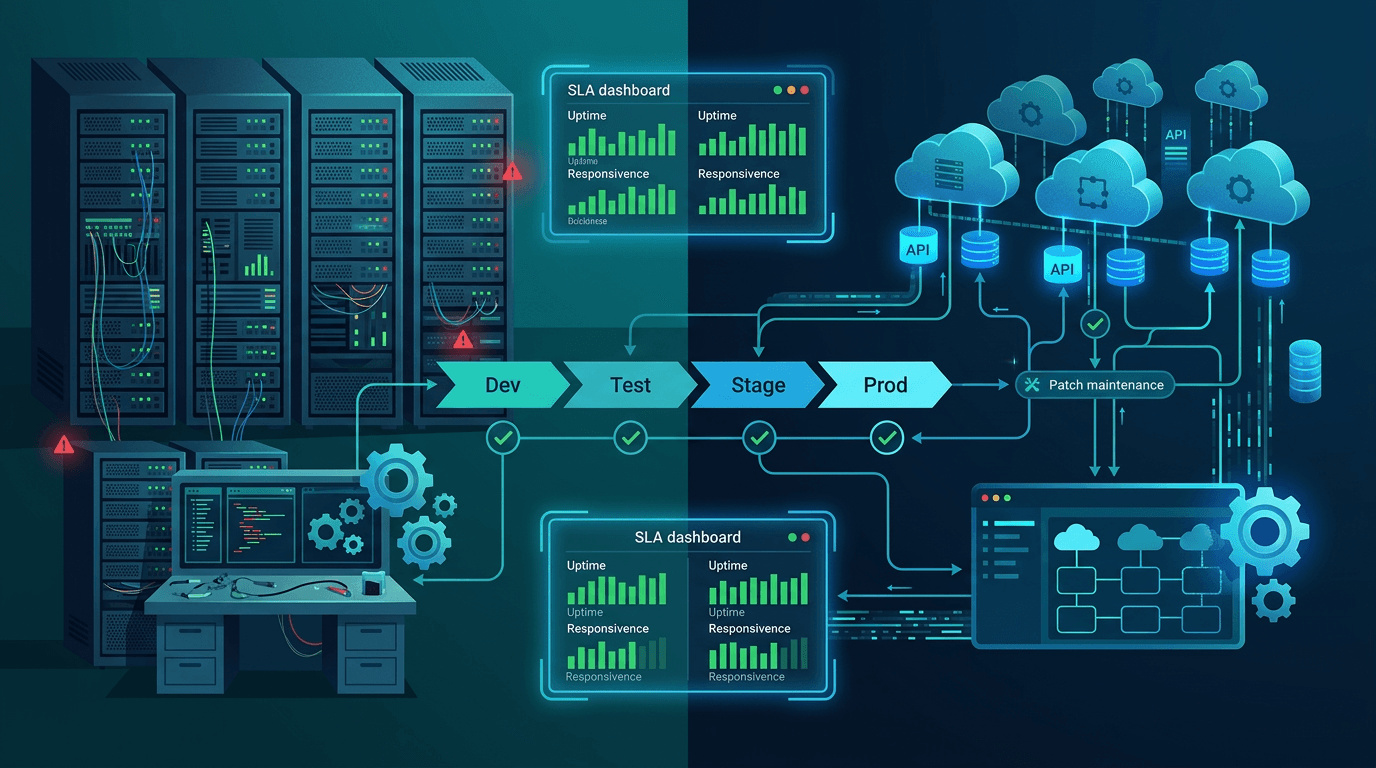
Hybrid environments require disciplined maintenance. KOMTEL keeps everything patched, monitored, and aligned with service-level targets so operational teams stay productive. Many IT teams react to failures — KOMTEL's approach is preventive: we work to stop the failure from happening at all, and when one does occur, recovery takes minutes, not days.
Lifecycle-aware patching
We plan patching around release cycles and criticality. Fast response to security patches is balanced with testing in a test environment and communication, so users stay confident in new versions.
There is no schedule that fits everyone. Some organisations can afford weekend maintenance windows, others have 24/7 operations where even a brief outage has financial consequences. In either case, patching can never be improvised — it must be planned, tested, and documented. Particularly critical patches, such as zero-day vulnerabilities, require a faster response, but even then testing in a non-production environment remains mandatory.
Automation and craftsmanship
Automation schedules configuration checks and remediation tasks. Engineers still oversee critical steps, but automation handles repeatable work while people redirect their attention to architecture, compliance, or migrations.
That said, automation is not a magic solution. A script that does the wrong thing does it quickly and at scale. That is why every automated routine goes through review and testing before it enters production. The combination of tooling and expertise — that is what genuinely works over the long term.
Alignment with SLAs
Operations reviews track availability, response time, and support load. KOMTEL uses those insights to proactively adjust maintenance schedules, add capacity, or expand coverage when demand grows.
An SLA is not just paperwork — it is a commitment. When 99.5% availability during business hours is agreed, that means a maximum of around 22 hours of downtime per year. Every outage is recorded, analysed, and used to improve the process. Clients receive regular compliance reports — not only when something goes wrong.
Real-world example
In the accounting services sector in BiH, a pattern repeats itself: servers slow down or crash exactly at tax deadline time — when pressure on the system is at its peak. The root cause is almost always the same: no maintenance schedule was ever implemented, updates are triggered automatically at random times, including during working hours. The fix is straightforward: schedule update windows for weekend nights, validate changes in a test environment, and set up monitoring that warns seven days in advance when disk or memory reaches 75% capacity. After this schedule is introduced — no more unexpected outages during critical periods.
Practical tip
Create a simple document — even just two pages — that describes every key system in your organisation: who is responsible for each one, when it was last updated, and when the next maintenance is scheduled. That document, kept up to date, is worth more than the most expensive monitoring tool — because without it, no tool can help if you do not know what you are looking at.
With a solid maintenance approach, hybrid workloads stay resilient and ready for the next release. What really makes the difference is not the tool or the script — it is a culture of thinking about the system before users do. If your IT team knows what is happening in the infrastructure before users notice it, you are doing it right.
If you are unsure whether your infrastructure is being maintained well enough — or if you are just starting to bring order to a system that has grown without a clear plan — the KOMTEL team can carry out an assessment and propose concrete next steps. Contact us to arrange an initial conversation with no commitment.